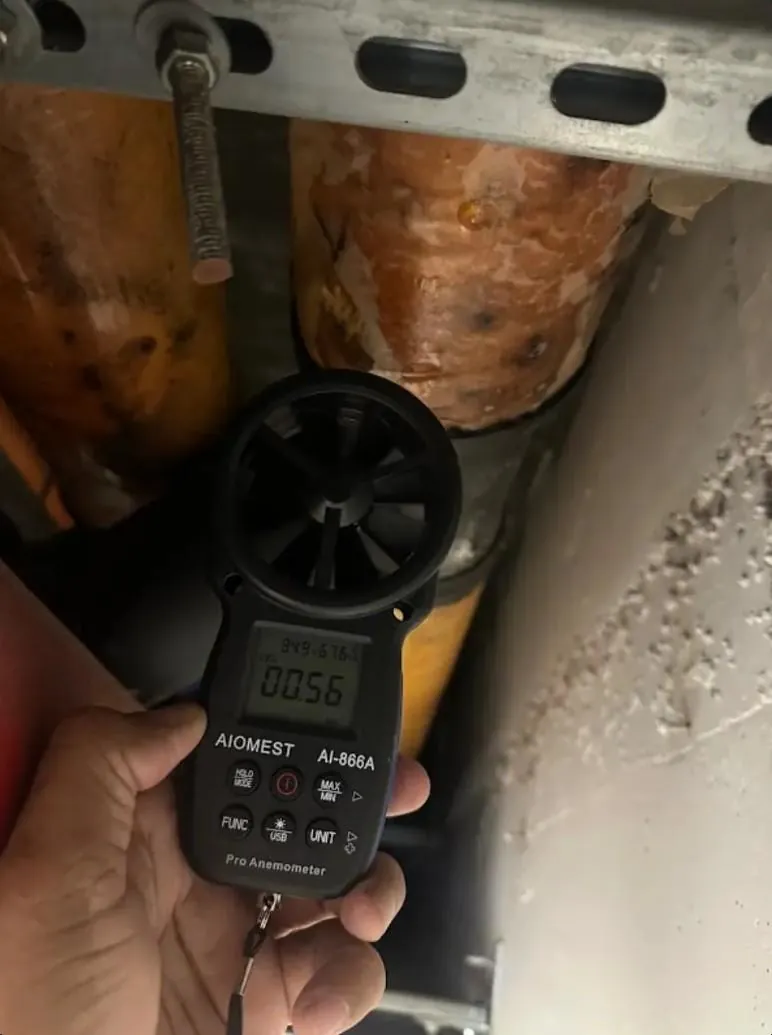
Why is a room not cooling even though the AC is running?
Equipment running does not mean cooling reaches the room. Damaged or leaking ducts, a restricted return path, dirty coils or filters, controls and heat or air entering the space can each reduce delivered performance. Measuring airflow and temperatures at the unit and the room shows where capacity is lost before deciding whether more equipment is actually needed.
Why are chilled-water pipes sweating despite insulation?
Condensation forms where a surface is colder than the surrounding air's dew point. On insulated pipes this can happen at gaps, damaged jacketing, unsealed joints, hangers or valves, or where humid air reaches the cold surface. Sweating does not by itself prove the insulation is wrong. Mapping surface temperature against local dew point along the run identifies condensation-prone locations; local humidity, air movement, insulation continuity and thickness, and vapor-barrier integrity should be assessed together before assigning a cause. A high ambient dew point can matter even where the insulation looks intact.
Moisture & Humidity →
Is it an airflow problem or a moisture problem?
Often both are involved. Weak airflow can leave a room warm and stuffy, while adequate airflow with poor moisture removal leaves it cool but clammy. Odor, condensation or mold suggest humidity is part of the problem; uneven temperatures suggest distribution. Measuring both separates the mechanisms so the correction targets the right system.
Moisture & Humidity →Guest Room Condensation →