Hospitality · Guest Room Condensation

Hotel Guest Room Condensation & Recurring Dampness

A room that feels cool can still have sweating windows, damp floors or a musty odor. LossPoint investigates why particular hotel rooms repeatedly develop condensation—and why cleaning, repainting or changing equipment has not kept it away.

Based in St. George’s, Grenada, Caribbean · Serving the Caribbean

Request an Investigation →

01

The complaint belongs to a room, not a stain

Guests and housekeeping may report wet glazing, clammy bedding, mold behind furniture or an odor on entry. In a guest room, thermostat settings, occupancy, a balcony door, bathroom exhaust and the air-conditioning unit interact within a small space. The same visible symptom can come from insufficient moisture removal, outdoor air infiltration or a surface that falls below the room air's dew point. A room-by-room comparison is more informative than assuming every complaint has the same cause.

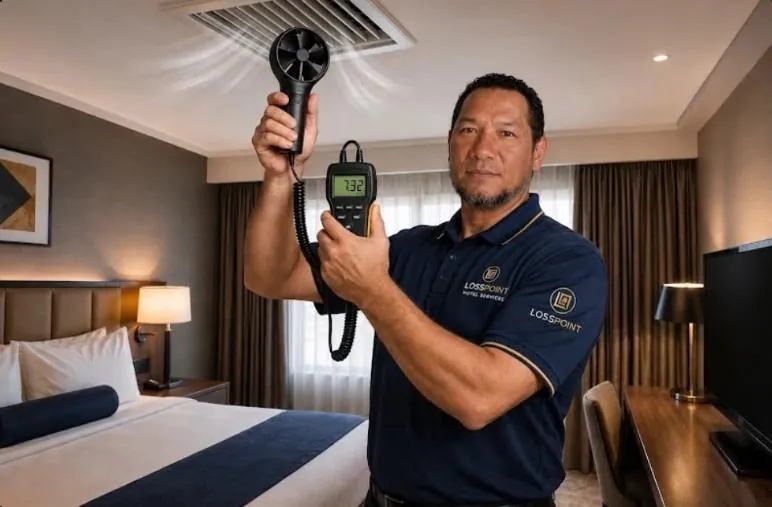
LossPoint investigator measuring airflow in a hotel guest room
LossPoint field photo · Guest-room airflow measurementLossPoint field photograph illustrating this type of investigation; not a record of every finding described below.

02

Investigate the room as an operating system

We compare affected rooms with suitable reference rooms and relate complaints to occupancy and operating patterns. Air and surface temperatures, relative humidity and dew point establish when condensation can form. Supply air, fan settings and cooling operation indicate whether the system removes moisture; checks of doors, balcony openings, room pressure and bathroom exhaust test how humid air enters or moves through the space. Measurements are selected to resolve the particular complaint, not applied identically to every room.

Measurements selected for the case

  • Room air and surface temperature, humidity and dew point
  • Supply-air conditions and cooling or fan operation
  • Balcony and door pathways, room pressure and bathroom exhaust

Specific to hotel guest rooms

This investigation addresses occupied hotel rooms and the consequences for guest comfort and room availability. It is deliberately narrower than a building-wide humidity study: findings are tied to the rooms and operating conditions actually assessed, not extrapolated to an entire property without evidence.

Return rooms to service with a testable correction

The result distinguishes the leading mechanism from the visible damage and identifies whether HVAC operation, air leakage, exhaust or room use needs attention. Recommendations can be checked against the same room conditions after the change. Repainting or cleaning may still be needed, but those actions cannot substitute for correcting the moisture condition.

Common questions about this problem

Why does a guest room feel cool but still damp?

Cooling and dehumidifying are related but different. Oversized equipment, short cycling, high fan settings or continuous outdoor-air entry can lower temperature while leaving humidity high. The room then feels clammy and surfaces can approach dew point. Measuring room humidity, supply conditions and run patterns shows whether moisture removal, air entry or operation needs correction.

HVAC Diagnostics →

Why do mold and odor come back after maintenance?

Cleaning, repainting or replacing a stained panel addresses what is visible, so growth and odor tend to return while the room stays humid or a surface stays cold and wet. Recurrence across several rooms often points to a shared condition: air entry, equipment operation or a building detail. Identifying that condition is what lets maintenance stop repeating.

Moisture & Humidity →

Can bathroom exhaust make a room more humid?

It can. Exhaust removes air that must be replaced; if the room is under negative pressure, humid outdoor air may be drawn in through door gaps, wall openings or the ceiling void. In the Caribbean that replacement air carries a lot of moisture. Checking pressure relationships and where make-up air enters shows whether exhaust and ventilation are working together or against the room.

Moisture & Humidity →HVAC Diagnostics →

Recurring guest-room moisture: beyond repainting

Observed condition

Hotel guest rooms kept returning with musty odors, high relative humidity, poor cooling and ceiling deterioration, despite repeated maintenance.

Investigation findings

LossPoint evaluated relative humidity, dew point, dry-bulb and wet-bulb temperatures, HVAC performance, building pressure, infiltration paths and exhaust performance. The published findings were elevated humidity and dew point, infiltration of warm, humid outdoor air, failed bathroom exhaust, thermostat calibration deficiencies and moisture introduced during cleaning. Combined, this latent load exceeded what the rooms could remove — a moisture-management failure rather than an HVAC equipment failure.

Corrective priorities · verification pending

Correction should address the combined moisture load — infiltration, bathroom exhaust, thermostat calibration and cleaning practice — rather than repainting or replacing equipment in isolation. Verification is still pending: comparable humidity, dew-point and temperature measurements under normal room operation will show whether the corrections hold.

Read published field case ↗

← Back to field investigations

Tell us which rooms are affected, what guests notice and whether complaints return after maintenance. Request a room-focused investigation.

Describe the condition

Where it happens and how long it has been recurring.

Add facility details (optional)
Conditions observed

We will review your message and contact you to agree scope and next steps.

Your contact details are used only to reply to you and assess your enquiry.

See an illustrative Technical Evidence Brief →